
MAXIDURA – HF-100: The Reliable Hardfacing Electrode for High-Impact Industrial Use
In demanding industries such as steel rolling, forging, and heavy metal processing, choosing the right hardfacing electrode for EN8 and EN9 steels is critical. Components like roughing rolls, rotary shear blades, and guide boxes operate under extreme sliding friction, repeated impact, and high temperatures. Standard electrodes often degrade quickly, resulting in costly downtime and reduced productivity.
MAXIDURA – HF-100 solves these problems. Designed specifically for medium carbon steels like EN-8 and EN-9, this basic-coated SMAW (Shielded Metal Arc Welding) electrode provides consistent performance in harsh environments. It combines strong weld integrity, high impact resistance, and wear protection.
What Makes HF-100 Ideal for EN8 and EN9 Steels
Unlike general-purpose electrodes, HF-100 withstands real-world industrial stress. It handles rolling motion, shock loads, and friction-heavy zones with confidence.
1. Direct Surfacing Without Buffer Layers
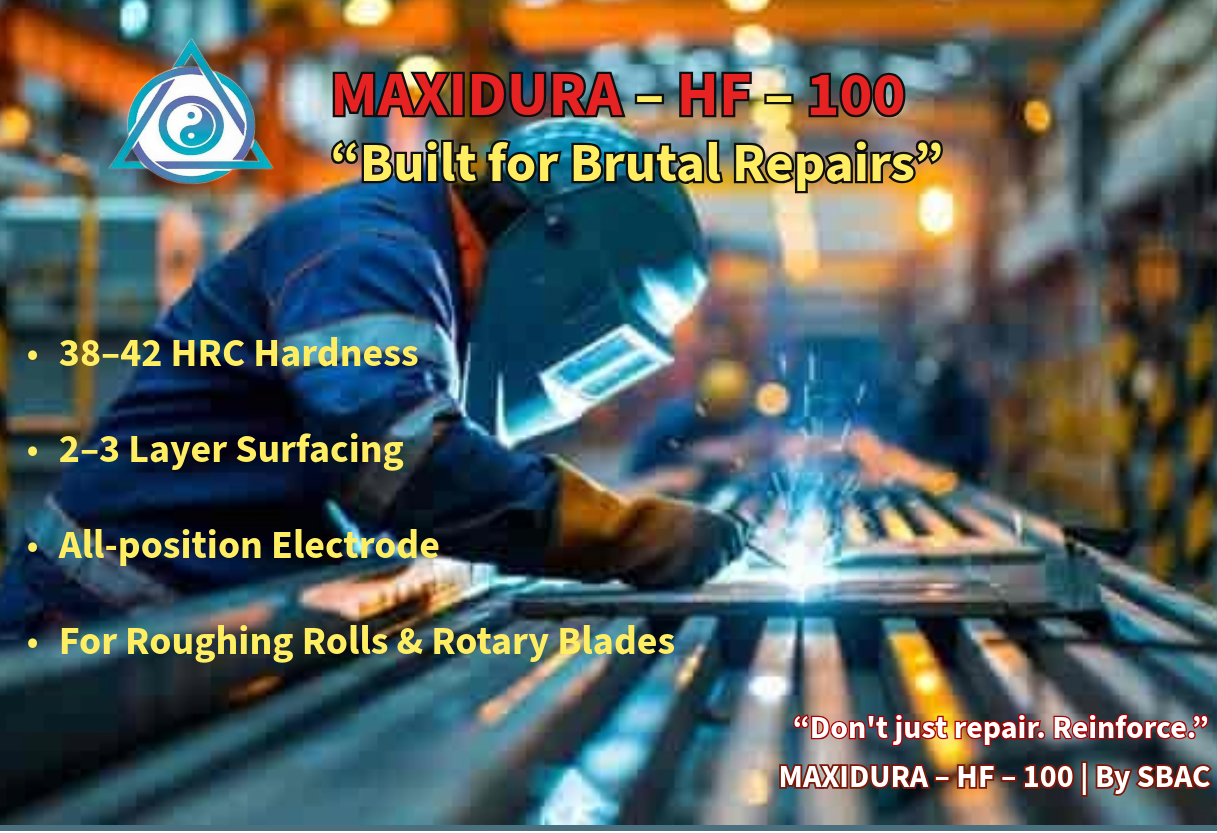
You can deposit 2–3 layers directly onto EN-series steels without needing buffer layers. This shortens the welding cycle and improves operational efficiency while ensuring solid metallurgical bonding.
2. Clean Weld Beads and Arc Stability
HF-100 maintains a stable arc with minimal spatter. As a result, you get smooth weld beads, reduced cleanup, and better energy efficiency. Welders consistently report high-quality results both in-shop and on-site.
3. Strong Hardness and Long-Term Strength
The weld achieves 38–42 HRC hardness. It resists abrasion, shock, and deformation, making it suitable for components under constant mechanical load.
Application Areas
MAXIDURA – HF-100 performs well in any industry where equipment experiences wear and impact.
Rolling and Guiding Components
-
Roughing rolls (EN-8 / EN-9)
-
Guide boxes
-
Pinch rolls
-
Sliding and rolling surfaces
Shearing and Cutting Tools
-
Rotary and cold shear blades
-
Tell breaker tips
Hot Work and Forging Zones
-
Low-alloy forging dies
-
Hot rolling components (except Adamite rolls)
These applications benefit from HF-100’s consistent deposition, low defect rate, and extended service life.
Electrode Compatibility Guide
Always choose the right electrode based on base metal compatibility.
| Base Material | Use of HF-100 | Recommended Electrode | Reason |
|---|---|---|---|
| Adamite Rolls | Avoid | MAXIDURA – HF-105 | Handles high-temperature abrasion |
| Manganese Steel | Avoid | MAXIDURA – HF-108 | Needs work-hardening support |
Welding Best Practices for HF-100
To achieve the best results with MAXIDURA – HF-100:
-
Preheat medium and high-carbon steels (EN-8 / EN-9) to 200–250°C before welding to reduce the risk of thermal cracking.
-
Allow the weld to cool naturally in still air. Do not use fans or water, as forced cooling can weaken the weld.
-
Always refer to the official Technical Data Sheet (TDS) for recommended amperage, polarity (AC/DC+), and electrode size.
Conclusion
If your operations demand durability under extreme pressure — especially when working with EN-8 and EN-9 steels — MAXIDURA – HF-100 is the hardfacing electrode you can trust. Its buffer-free surfacing, clean arc characteristics, and high hardness make it a dependable welding solution for tough industrial environments.
By switching to MAXIDURA – HF-100, you’ll extend component life, reduce maintenance frequency, and achieve consistent weld performance — whether you’re working in a rolling mill, a forge shop, or a steel processing plant.